


The Weekly Wealth Watch
June 1, 2026
The Markets
The key to long-term success is not being right all the time—it’s managing risk when you’re wrong.” — Michael Platt, (BlueCrest Capital)
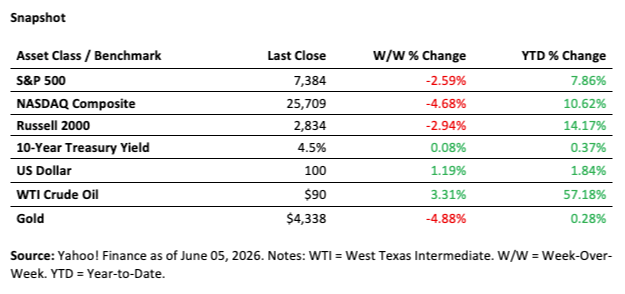
U.S. equity markets pulled back this week as investors took a more cautious stance following a strong year-to-date advance. The S&P 500 declined –2.59%, though it remains higher by +7.86% for the year. Technology stocks experienced a sharper correction, with the NASDAQ Composite falling –4.68%, trimming its year-to-date gain to +10.62%. Small-cap stocks also came under pressure, as the Russell 2000 declined –2.94%, though it continues to lead major benchmarks with a +14.17% gain year-to-date. The broad-based weakness suggests investors were reducing risk exposure rather than rotating between sectors.
In fixed income, the 10-Year Treasury yield rose +0.08%, finishing the week at 4.5%. The increase in yields alongside weaker equity markets reflects continued sensitivity to inflation expectations and interest rate policy.
Currency markets moved higher, with the U.S. dollar rising +1.19%, extending its year-to-date gain to +1.84%. A stronger dollar can create headwinds for global liquidity and risk assets, particularly when accompanied by rising interest rates.
Commodities delivered mixed results. WTI crude oil advanced +3.31%, extending its year-to-date gain to +57.18% and reinforcing energy’s continued influence on the macroeconomic landscape. Meanwhile, gold declined –4.88%, leaving it only modestly positive for the year at +0.28%. The combination of higher yields and a stronger dollar likely weighed on precious metals during the week.
Taken together, the cross-asset picture reflects a market undergoing a period of recalibration. Equities retreated, yields and the dollar moved higher, energy prices continued to climb, and gold weakened. While the pullback may feel uncomfortable after an extended advance, the broader trend remains constructive, with major indexes still maintaining solid year-to-date gains.
Consistent with Michael Platt’s emphasis on risk management, this week's market action serves as a reminder that successful investing is not about avoiding volatility, but about navigating it with discipline and perspective.
A Hitchhiker's Guide to the Space Economy
"The Earth is the cradle of humanity, but mankind cannot stay in the cradle forever." — Konstantin Tsiolkovsky
Don't Panic ... Buy a Towel (and Maybe a Rocket)
With the highly anticipated IPO of SpaceX approaching, investors are asking a fascinating question: How do you value an economy that stretches beyond Earth?
The global space economy currently generates roughly $400–600 billion annually, with forecasts approaching $1.8 trillion by 2035. That's impressive growth—but not quite "infinite universe, infinite profits" impressive.
As every science-fiction fan eventually learns, space may be limitless, but investment returns are not.
Gravity: The Ultimate Cost Center
Space investing faces one stubborn challenge: Gravity.
Every extra mile per hour of rocket speed requires exponentially more fuel. As rocket pioneer Tsiolkovsky discovered, profit margins in space are literally weighed down by physics.
"Reality is frequently inaccurate." — Douglas Adams
Investors dreaming of asteroid mining fortunes should remember that if someone suddenly flooded Earth with asteroid gold, the price of gold would likely collapse. Scarcity—not abundance—creates value.
Three Space Themes Worth Watching
1. Orbital Data Centers
Space offers abundant solar energy and naturally cold temperatures. Future AI infrastructure may someday float above Earth rather than sit on it.
2. The New Fuel Economy
In a mature space economy, energy and propulsion ("Delta-V") may become more valuable than traditional currencies.
3. Earth First, Space Second
For now, space remains a service provider to Earth—delivering internet, communications, navigation, defense, and data.
The key takeaway: Space may be enormous, but its success still depends on solving problems here at home.
Bottom Line
The space economy isn't a fantasy anymore—it's becoming a legitimate asset class. Yet investors should balance excitement with realism. The opportunities are enormous, but so are the engineering challenges.
As author Arthur C. Clarke famously observed:
"The only way of discovering the limits of the possible is to venture a little way past them into the impossible."
For investors, the journey may prove just as exciting as the destination.
Strive For Perfection, Achieve Excellence
"Prediction is very difficult, especially about the future." — Niels Bohr
Markets, much like rockets, rarely travel in straight lines.
While investors remain focused on geopolitical risks, inflation headlines, and interest rates, the bigger story continues to be productivity. Artificial intelligence, cloud computing, and automation are helping businesses accomplish more with fewer resources—a powerful force for earnings growth.
Just as the space economy represents humanity expanding beyond old boundaries, AI represents businesses expanding beyond traditional productivity limits.
Markets don't need perfection. They simply need progress.
Human Interest
A recent survey found that a growing number of children now say they want to become astronauts, engineers, or robotics experts—careers that barely existed a generation ago.
"Shoot for the moon. Even if you miss, you'll land among the stars." — Norman Vincent Peale
The next generation may view space the same way previous generations viewed the internet: Not as science fiction, but as science fact.
Fun Facts & Figures
🚀 A rocket launch reaches orbit in about 8–9 minutes.
🌎 Earth travels around the Sun at roughly 67,000 miles per hour.
🛰️ More than 10,000 active satellites now orbit Earth.
💻 A modern smartphone contains vastly more computing power than NASA had available during the Apollo missions.
On This Day in History – June 8
🚀June 8, 1966: Surveyor 1 became the first U.S. spacecraft to achieve a soft landing on the Moon and transmit detailed images back to Earth.
"That's one small step for man, one giant leap for mankind." — Neil Armstrong
Every giant leap starts with a countdown.
Sources & Footnotes:
- World Economic Forum, global space economy projections.
- Industry estimates for 2025–2026 global space economy revenues.
- Company-reported 2025 revenue figures for SpaceX.
- Tsiolkovsky Rocket Equation and foundational aerospace engineering principles.
- Visual Capitalist estimates of global equity market capitalization.
- Research on the Kardashev Scale and long-term civilization development.
- NASA historical archives regarding Surveyor 1 lunar landing.
- Bureau of Economic Analysis (BEA) and productivity-related economic data.
- WCG research and analysis, June 2026.
Disclosures:
- Securities offered through LPL Financial, Member FINRA/SIPC. Investment Advice offered through WCG Wealth Advisors, LLC, a Registered Investment Advisor. WCG Wealth Advisors, LLC is a separate entity from LPL Financial.
- Bond yields are subject to change. Certain call or special redemption features may exist which could impact yield. (118-LPL)
- The S&P 500 is a stock market index tracking the stock performance of 500 of the largest companies listed on stock exchanges in the United States. Indexes are unmanaged and cannot be invested in directly. (102-LPL)
- The NASDAQ Composite Index measures all NASDAQ domestic and non-U.S. based common stocks listed on The NASDAQ Stock Market. The market value, the last sale price multiplied by total shares outstanding, is calculated throughout the trading day, and is related to the total value of the Index. Indexes are unmanaged and cannot be invested in directly. (112-LPL)
- The fast price swings in commodities will result in significant volatility in an investor’s holdings. Commodities include increased risks, such as political, economic, and currency instability, and may not be suitable for all investors. (122-LPL)
- There is no guarantee that a diversified portfolio will enhance overall returns or outperform a non-diversified portfolio. Diversification does not protect against market risk. (26-LPL)
The Russell 2000 Index is generally representative of the 2,000 smallest companies by market capitalization in the Russell 3000 index, which represents approximately 10% of the total market capitalization of the Russell 3000 Index. Indexes are unmanaged and cannot be invested in directly. Bonds are subject to market and interest rate risk if sold prior to maturity. Bond values will decline as interest rates rise. Bonds are subject to availability, change in price, call features and credit risk. The fast price swings in commodities will result in significant volatility in an investor’s holdings. Commodities include increased risks, such as political, economic, and currency instability, and may not be suitable for all investors.
Securities offered through LPL Financial, Member FINRA/SIPC. Investment Advice offered through WCG Wealth Advisors, LLC, a Registered Investment Advisor. WCG Wealth Advisors, LLC is a separate entity from LPL Financial.