


The Weekly Wealth Watch
July 13, 2026
The Markets
“Investing isn't just about owning great companies—it's about understanding how they create long-term value for all stakeholders.” — Jeff Ubben, Founder, (Inclusive Capital Partners)
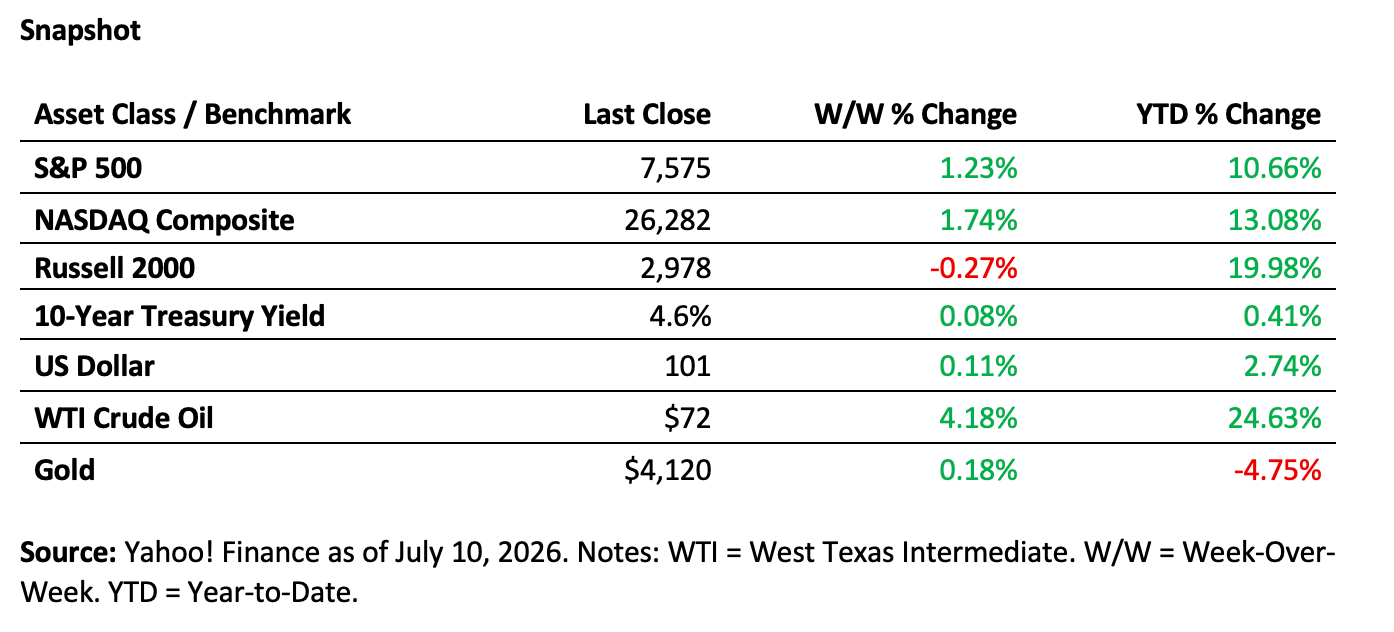
Markets continued their steady advance this week as investors looked beyond near-term uncertainty and focused on resilient corporate fundamentals. The S&P 500 gained +1.23%, lifting its year-to-date return to +10.66%. Technology shares remained a source of leadership, with the NASDAQ Composite advancing +1.74%, bringing its year-to-date gain to +13.08%. Meanwhile, the Russell 2000 slipped –0.27% for the week but continues to outperform the broader market with an impressive +19.98% gain year-to-date.
In fixed income, the 10-Year Treasury yield increased +0.08%, finishing the week at 4.6%. The modest rise in yields suggests investors continue to balance expectations for economic growth, inflation, and the path of future Federal Reserve policy while remaining confident in the broader economic outlook.
The U.S. dollar edged higher by +0.11%, extending its year-to-date advance to +2.74%. A firmer dollar can create headwinds for multinational earnings and commodity prices, although its impact remained relatively muted during the week.
Commodity markets were broadly constructive. WTI crude oil rose +4.18%, increasing its year-to-date gain to +24.63%. Oil prices continued to reflect evolving expectations surrounding global demand, supply discipline, and ongoing geopolitical developments. Gold also posted a modest gain of +0.18% during the week but remains –4.75% year-to-date, suggesting investors continue to favor risk assets while maintaining selective exposure to traditional safe-haven investments.
Overall, this week's market action reflected a constructive backdrop. Equities continued to trend higher, Treasury yields moved modestly upward, the U.S. dollar strengthened slightly, and commodities remained resilient. While individual asset classes continue to respond to shifting economic and geopolitical developments, the broader market has demonstrated an ability to absorb uncertainty without losing sight of longer-term fundamentals.
As Jeff Ubben reminds us, successful investing is about understanding how companies create durable, long-term value rather than becoming distracted by short-term market fluctuations. This week's performance reinforces that disciplined investors are often best served by focusing on fundamental business strength and maintaining a long-term perspective, even as markets continue to navigate an evolving economic landscape.
The Wisdom of Breadth
Are We Floating Toward a Market Bubble… or Simply Riding a Strong Breeze?
“The investor's chief problem—and even his worst enemy—is likely to be himself.” — Benjamin Graham
The stock market has delivered extraordinary returns since the October 2022 bear market low. The S&P 500 has climbed more than 114%, artificial intelligence has fueled remarkable gains in select companies, and headlines celebrating new millionaires have become increasingly common. It is only natural that investors begin asking an important question:
Are today's markets approaching bubble territory, or are we simply witnessing a strong bull market supported by improving fundamentals?
Rather than relying on one statistic or one headline, the answer requires examining what technicians often call the weight of the evidence.
Wall Street Wisdom
Learning to Separate Optimism from Euphoria
“Bull markets are born on pessimism, grow on skepticism, mature on optimism, and die on euphoria.” — Sir John Templeton
Sir John Templeton understood that markets move through emotional cycles. Strong returns alone do not signal a bubble. Instead, bubbles typically form when optimism turns into widespread euphoria and investors begin believing that prices can only move higher.
While the market has delivered impressive gains since the October 2022 bear market low, the broader evidence tells a more balanced story. Investor sentiment remains cautious, trillions of dollars are still sitting in money market funds, and much of the market's advance has been supported by earnings growth rather than expanding valuations.
Templeton's wisdom reminds us that successful investing isn't about predicting the next bubble. It's about remaining disciplined, evaluating the weight of the evidence, and resisting the temptation to let either fear or excitement drive long-term investment decisions.
Thematic Section
The Bubble Checklist: Signs That Look Frothy
“The essence of investment management is the management of risks, not the management of returns.” — Benjamin Graham
Whenever markets deliver exceptional returns, investors naturally begin asking whether prices have become detached from reality. Strong performance alone, however, has never been enough to define a bubble. The more important question is whether the broader evidence supports that conclusion.
On one hand, there are certainly signs that deserve attention: the S&P 500’s strong performance, margin debt has risen, technology now represents a significant portion of the index, and excitement surrounding artificial intelligence has fueled extraordinary gains in select companies. These are characteristics investors should monitor carefully.
On the other hand, several important indicators tell a different story. Investor sentiment remains surprisingly cautious, approximately $8 trillion continues to sit in money market funds, earnings—not expanding valuation multiples—have driven much of the market's recent advance, and market participation remains healthier than what has typically been observed during previous speculative peaks.
The lesson is straightforward: successful investing isn't about reacting to a single headline or valuation metric. It requires evaluating the complete picture. Markets often send mixed signals, and that's precisely why disciplined investors rely on the weight of the evidence rather than any single indicator.
Rather than asking whether today's market "feels" like a bubble, perhaps the better question is whether the evidence truly supports that conclusion. At least for now, the answer appears far more balanced than many headlines suggest.
Human Interest
A Celebration, a Dog, and a Question About Markets
“Every past market decline looks like an opportunity. Every future decline looks like a risk.” — Morgan Housel
A family's Independence Day celebration was filled with red, white, and blue decorations, good food, and plenty of laughter. Everything was going according to plan until the family dog decided the balloons looked too tempting to resist. One by one, they popped, drawing everyone's attention before the laughter quickly returned.
Later that evening, as fireworks lit up the sky, it sparked an interesting thought: markets often behave the same way. A loud headline, a sharp rally, or sudden volatility can quickly capture our attention and make us wonder whether something much bigger is unfolding.
Are we witnessing the early stages of a market bubble, or simply a strong bull market? The answer, as always, lies not in reacting to the loudest noise but in evaluating the weight of the evidence before drawing conclusions.
Sometimes, a popping balloon is just a popping balloon—and sometimes the market's loudest headlines deserve the same perspective.
Fun Facts & Figures
Bubble Facts That May Surprise You
“It ain't what you don't know that gets you into trouble. It's what you know for sure that just ain't so.” — Commonly attributed to Mark Twain
📈 114% Rally — Since the October 13, 2022 bear market low, the S&P 500 has gained more than 114%, one of the strongest advances of the current bull market.
💰 $8 Trillion on the Sidelines — Investors continue to hold approximately $8 trillion in money market funds. Historically, major market bubbles tend to occur when investors are fully invested—not when large amounts of cash remain on the sidelines.
📊More Bears Than Bulls — According to the AAII survey, 42% of retail investors were bearish, compared with only 31% bullish. Extreme optimism has historically been a hallmark of market bubbles, making today's sentiment surprisingly cautious.
📉 Breadth Remains Healthy — Approximately 68% of S&P 500 companies trade above their 200-day moving average. That's healthy participation—but still well below the levels typically seen during past speculative peaks.
📈 Earnings Still Matter — Roughly 33% of the S&P 500's one-year return has been driven by earnings growth, while valuation multiples have actually contracted. Strong earnings support is rarely associated with classic speculative bubbles.
🏦 Margin Debt Hits $1.42 Trillion — Higher borrowing can amplify gains during bull markets, but it can also magnify losses when markets reverse, making leverage an important indicator to monitor.
💻Technology's Growing Influence — Information Technology now represents 37.29% of the S&P 500 Index, highlighting both the market's concentration in AI-related companies and the importance of diversification.
On This Day in History – July 13
“History is a vast early warning system.” — Norman Cousins
The Live Aid Concert Unites the World (1985)
On July 13, 1985, millions of people around the world watched Live Aid, a pair of benefit concerts held simultaneously in London and Philadelphia to raise funds for famine relief in Ethiopia. Featuring legendary artists including Queen, U2, David Bowie, Elton John, and Phil Collins, the event demonstrated the extraordinary power of people working together toward a common purpose.
For investors, the lesson extends beyond music. History often reminds us that long-term progress is driven by innovation, cooperation, resilience, and the willingness to solve problems rather than simply react to them. Just as markets experience periods of uncertainty, history shows that optimism, adaptability, and collective action often prevail over time.
Other July 13 Milestones
🚀 1923 — The iconic Hollywood Sign was officially dedicated in Los Angeles. Originally intended as a real estate advertisement, it evolved into one of the world's most recognizable symbols of entertainment and creativity.
⚾ 1930 — The inaugural FIFA World Cup officially began in Uruguay, launching what would become the world's largest sporting event and a global celebration of competition and unity.
💻 1962 — Telstar 1, the world's first active communications satellite, successfully transmitted television signals across the Atlantic, transforming global communications and laying the foundation for today's connected world.
📈 1990 — The Dow Jones Industrial Average closed above 3,000 points for the first time, reflecting growing confidence in the U.S. economy and marking a significant milestone in market history.
🌎 2016 — Scientists announced the successful completion of one of the most comprehensive global climate observation datasets, providing researchers with valuable insights into long-term environmental trends and demonstrating the growing role of data in scientific discovery.
“The more you know about the past, the better prepared you are for the future.”— Theodore Roosevelt
Sources & Footnotes:
- WCG Weekly Input: "A Bubble or Not?" July 8, 2026. The Wealth Consulting Group. Primary source for this week's feature theme, market analysis, and investment commentary.
- Bloomberg Finance L.P. Market performance, S&P 500 Index returns, CAPE Ratio, Information Technology weighting, top-10 index concentration, earnings attribution, and market breadth statistics referenced in the WCG Weekly Input.
- Financial Industry Regulatory Authority (FINRA). Margin debt balances (May 2026), as referenced in the WCG Weekly Input.
- American Association of Individual Investors (AAII). Investor Sentiment Survey (July 2, 2026), reporting 42% bearish and 31% bullish individual investors.
- Board of Governors of the Federal Reserve System. Money market fund and cash balance data referenced in the WCG Weekly Input (July 1, 2026).
- University of Michigan Surveys of Consumers. Consumer Sentiment Index (June 30, 2026), illustrating that consumer confidence remains near multi-decade lows.
- National Bureau of Economic Research (NBER). Goetzmann, William N., Bubble Investing: Learning from History (Working Paper No. 21693). Referenced regarding the historical difficulty of accurately identifying market bubbles in real time.
- The New York Times. "SpaceX Created 4,400 Millionaires, Nearly 400 Worth $100 Million or More," June 12, 2026. Referenced in the WCG Weekly Input as an example of wealth creation during the current AI and private-market investment cycle.
- Encyclopedia Britannica and the Library of Congress. Historical reference materials used for the On This Day in History section, including the 1985 Live Aid concert, the Hollywood Sign dedication, the first FIFA World Cup, Telstar 1, and other historical milestones.
- Quotations are attributed to Benjamin Graham, Sir John Templeton, Morgan Housel, Aldous Huxley, Norman Cousins, and Theodore Roosevelt. Quotations are used for educational and inspirational purposes and do not constitute investment advice.
Disclosures:
- Securities offered through LPL Financial, Member FINRA/SIPC. Investment Advice offered through WCG Wealth Advisors, LLC, a Registered Investment Advisor. WCG Wealth Advisors, LLC is a separate entity from LPL Financial.
- Bond yields are subject to change. Certain call or special redemption features may exist which could impact yield. (118-LPL)
- The S&P 500 is a stock market index tracking the stock performance of 500 of the largest companies listed on stock exchanges in the United States. Indexes are unmanaged and cannot be invested in directly. (102-LPL)
- The NASDAQ Composite Index measures all NASDAQ domestic and non-U.S. based common stocks listed on The NASDAQ Stock Market. The market value, the last sale price multiplied by total shares outstanding, is calculated throughout the trading day, and is related to the total value of the Index. Indexes are unmanaged and cannot be invested in directly. (112-LPL)
- The fast price swings in commodities will result in significant volatility in an investor’s holdings. Commodities include increased risks, such as political, economic, and currency instability, and may not be suitable for all investors. (122-LPL)
- There is no guarantee that a diversified portfolio will enhance overall returns or outperform a non-diversified portfolio. Diversification does not protect against market risk. (26-LPL)
The Russell 2000 Index is generally representative of the 2,000 smallest companies by market capitalization in the Russell 3000 index, which represents approximately 10% of the total market capitalization of the Russell 3000 Index. Indexes are unmanaged and cannot be invested in directly. Bonds are subject to market and interest rate risk if sold prior to maturity. Bond values will decline as interest rates rise. Bonds are subject to availability, change in price, call features and credit risk. The fast price swings in commodities will result in significant volatility in an investor’s holdings. Commodities include increased risks, such as political, economic, and currency instability, and may not be suitable for all investors.
Securities offered through LPL Financial, Member FINRA/SIPC. Investment Advice offered through WCG Wealth Advisors, LLC, a Registered Investment Advisor. WCG Wealth Advisors, LLC is a separate entity from LPL Financial.