


The Weekly Wealth Watch
August 31, 2026
The Markets
“The stock market is the story of cycles and of the human behavior that is responsible for overreactions in both directions.” — Seth Klarman, The Baupost Group
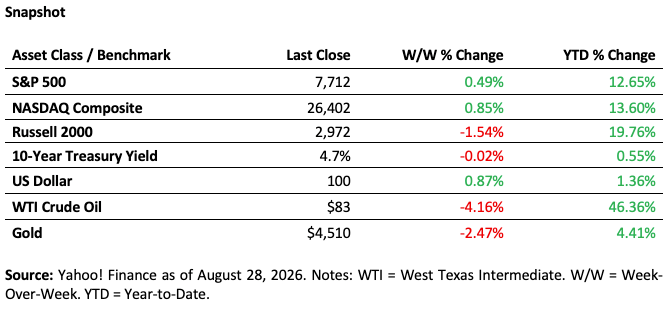
U.S. equity markets moved modestly higher this week, although performance beneath the surface remained mixed. The S&P 500 advanced +0.49%, lifting its year-to-date return to +12.65%. Technology shares provided additional strength, with the NASDAQ Composite gaining +0.85%, bringing its year-to-date return to +13.60%. Small-cap stocks moved in the opposite direction, as the Russell 2000 declined –1.54% for the week. Despite the pullback, small caps remain higher by a strong +19.76% year-to-date.
In fixed income, the 10-Year Treasury yield declined –0.02%, finishing the week at 4.7%. The relatively small move in yields reflected a stable Treasury market as investors continued to assess economic growth, inflation, and the outlook for monetary policy.
The U.S. dollar strengthened +0.87% during the week, increasing its year-to-date gain to +1.36%. The stronger dollar coincided with weakness across commodities and highlighted the differing forces influencing asset classes as investors repositioned portfolios.
Commodity markets moved lower. WTI crude oil declined –4.16%, though it remains substantially higher by +46.36% year-to-date. Gold fell –2.47%, reducing its year-to-date gain to +4.41%. The pullbacks in both commodities came after periods of significant volatility and demonstrate how quickly leadership can shift across markets.
Overall, this week's market action reflected a mixed but generally constructive environment. Large-cap equities advanced, technology outperformed, small caps retreated, Treasury yields were relatively stable, the dollar strengthened, and commodities gave back some recent gains. The divergence across asset classes reinforces an important investment principle: markets rarely move together, and leadership can rotate quickly as economic conditions and investor expectations evolve.
As Seth Klarman reminds us, markets are shaped not only by fundamentals but also by cycles and human behavior. Short-term swings can create both optimism and anxiety, but disciplined investors are often better served by maintaining perspective, focusing on underlying value, and resisting the temptation to overreact to either direction of the market cycle.
Show Me, Don’t Tell Me
The market continues to climb its wall of worry, while investors keep one eye on earnings and the other on the consumer. The big story this week: Households may say they’re worried, but their wallets are still doing plenty of talking.
As Peter Lynch famously put it, “Know what you own, and know why you own it.” For consumers, the same principle seems to apply: Know what you need, know what you want—and wait for the sale on everything else.
Actions Speak Louder Than Words
Consumer confidence may be gloomy, but consumer behavior is telling a different story.
The wealth effect is doing some heavy lifting. Rising stock and asset prices are supporting spending among higher-income households, creating a positive feedback loop:
Higher asset prices → more spending → stronger sales → better earnings → higher stock prices.
That's the market's version of a perpetual-motion machine—at least until somebody forgets to plug it in.
And while retail sales have recently slowed, some of that weakness reflects temporary factors, including the timing of income-tax refunds and Amazon Prime Day.
As economist John Maynard Keynes observed, “In the long run we are all dead.” Fortunately, consumers appear to be alive, employed and still shopping.
$166 Billion: The Tariff Refund
The Supreme Court's February 2026 decision striking down the IEEPA tariffs triggered an estimated $166 billion in refunds to U.S. importers.
That's a lot of money finding its way back into corporate pockets.
The interesting question isn't simply whether companies receive the money. It's what they do with it.
Corporate Split: Volumes vs. Margins
Walmart:“Let's cut prices.”
The company received roughly $2.9 billion and announced 11,000 price rollbacks, particularly in groceries and general merchandise.
Target, Home Depot & Lowe's:“Let's protect margins.”
These retailers are using the windfall primarily to reduce costs and improve profitability.
TJX:“Let's share the love.”
The company used part of its refund for employee incentives and bonuses.
Same check. Very different shopping lists.
Big Retail: Let the Results Speak for Themselves
The 2Q26 results suggest consumers aren't retreating—they're optimizing.
- Target: +100.49% Y/Y normalized EPS growth.
- BJ's:+15.73% Y/Y revenue growth.
- Home Depot: +5.71% Y/Y revenue growth and a 1.35% revenue beat.
- Lowe's:+8.34% Y/Y revenue growth despite a 0.56% revenue miss.
- TJX:+10.91% Y/Y normalized EPS growth.
And here's the kicker: Every retailer in the comparison beat both normalized and GAAP EPS estimates.
As Walmart founder Sam Walton said, “There is only one boss: The customer.” Apparently, today's boss wants value, value and more value.
Human Interest
Today's consumer is basically standing in the grocery aisle with a calculator.
“Do I need it?”
“Can I get it cheaper?”
“Is there a coupon?”
“Does Walmart have it?”
This isn't necessarily a broken consumer. It's a strategic consumer.
The behavior resembles an old saying attributed to Benjamin Franklin: “A penny saved is a penny earned.” In 2026, that penny may also be earning interest by avoiding a 24% credit-card APR.
Fun Facts & Figures
🛒11,000:Walmart price rollbacks in 2Q26.
💰$166 billion:Estimated tariff refunds to U.S. importers.
📈100.49%: Target's Y/Y normalized EPS growth.
🏪15.73%: BJ's Y/Y revenue growth.
👕10.91%: TJX's normalized EPS growth.
The common denominator? Consumers are still spending—but they're shopping smarter.
On This Day in History – August 31
On August 31, 1997, Princess Diana died in a car crash in Paris, prompting an extraordinary global outpouring of grief.
Her life—and the world's reaction to her death—was a powerful reminder that behind all the numbers, charts and economic statistics are human beings.
As Diana famously said, “Carry out a random act of kindness, with no expectation of reward.”
Markets measure dollars. People measure something much harder to quantify.
Bottom Line
Don't listen only to what consumers say. Watch what they do.
The evidence suggests households aren't retrenching. They're trading down, hunting for value and prioritizing necessities while postponing big-ticket purchases.
That's not a consumer recession. It's a consumer adjustment.
And if Walmart's price cuts trigger a broader retail price war, consumers could get another bonus: Lower prices plus more purchasing power.
As the old investment saying goes: The proof is in the pudding.
In this case, the pudding is apparently on sale.
Sources & Footnotes:
- Federal Reserve Economic Data (FRED), consumer spending and income data; WCG, 08/24/26.
- S&P Global, consumer and retail data; WCG, 08/24/26.
- Supreme Court of the United States, February 2026 IEEPA tariff decision; WCG analysis.
- Seeking Alpha, 2Q26 company earnings data; WCG, 08/24/26.
- Walmart, Target, BJ's Wholesale Club, Home Depot, Lowe's and TJX 2Q26 company results and guidance.
- Historical quotation sources: John Maynard Keynes, A Tract on Monetary Reform (1923); Sam Walton, Sam Walton: Made in America (1992); Princess Diana public remarks.
Disclosures:
Securities offered through LPL Financial, Member FINRA/SIPC. Investment Advice offered through WCG Wealth Advisors, LLC, a Registered Investment Advisor. WCG Wealth Advisors, LLC is a separate entity from LPL Financial.
Bond yields are subject to change. Certain call or special redemption features may exist which could impact yield. (118-LPL)
The S&P 500 is a stock market index tracking the stock performance of 500 of the largest companies listed on stock exchanges in the United States. Indexes are unmanaged and cannot be invested in directly. (102-LPL)
The NASDAQ Composite Index measures all NASDAQ domestic and non-U.S. based common stocks listed on The NASDAQ Stock Market. The market value, the last sale price multiplied by total shares outstanding, is calculated throughout the trading day, and is related to the total value of the Index. Indexes are unmanaged and cannot be invested in directly. (112-LPL)
The fast price swings in commodities will result in significant volatility in an investor’s holdings. Commodities include increased risks, such as political, economic, and currency instability, and may not be suitable for all investors. (122-LPL)
There is no guarantee that a diversified portfolio will enhance overall returns or outperform a non-diversified portfolio. Diversification does not protect against market risk. (26-LPL)
The Russell 2000 Index is generally representative of the 2,000 smallest companies by market capitalization in the Russell 3000 index, which represents approximately 10% of the total market capitalization of the Russell 3000 Index. Indexes are unmanaged and cannot be invested in directly. Bonds are subject to market and interest rate risk if sold prior to maturity. Bond values will decline as interest rates rise. Bonds are subject to availability, change in price, call features and credit risk. The fast price swings in commodities will result in significant volatility in an investor’s holdings. Commodities include increased risks, such as political, economic, and currency instability, and may not be suitable for all investors.
Securities offered through LPL Financial, Member FINRA/SIPC. Investment Advice offered through WCG Wealth Advisors, LLC, a Registered Investment Advisor. WCG Wealth Advisors, LLC is a separate entity from LPL Financial.
1167565